

Stock Research Note – HDFC Bank Ltd
This is a Long-term (3-5 year) valuation study of HDFC Bank Stock and not a buy/sell recommendation
Basic Details
Detailed Report
| Stock Name | HDFC Bank Ltd |
| NSE Code | HDFCBANK |
| Current Price | Rs 710 (as on 3 Sep 2026) |
| Down from 1 Year Ago | ~25% to 26% |
| Down from All-Time High | ~30% (all-time high Rs 1,020.50, hit as recently as October 2025) |
PE Ratio Check
| Current PE | ~13.8x |
| 3-Year Average PE | ~18.8x -> current PE is about 26% below this |
| 5-Year Average PE | ~19.5x -> current PE is about 29% below this |
This is a meaningfully bigger discount than what we typically see for a stock this size and quality. In fact, independent data sources place HDFC Bank’s current PE very close to its actual 10-year low, and well below its 10-year median PE. That alone makes this one worth digging into properly rather than assuming it is simply out of favour.
Detailed Report
Why Has the Stock Fallen So Much?
Unlike a stock that falls because its business is struggling, HDFC Bank’s profit has grown every single year over the last five years (see chart below). The fall is almost entirely a valuation/profitability-quality story tied to one structural event:
- The July 2023 reverse merger with parent HDFC Ltd: This brought in about Rs 6.5 lakh crore of home loan mortgages onto the bank’s books. Mortgages carry a much lower net interest margin (2-2.5%) than HDFC Bank’s older, more profitable retail/SME loan mix (4%+), which mechanically dragged down the blended margin for the combined entity.
- Falling CASA (low-cost deposit) share: The proportion of cheap current and savings account money funding the bank has slipped from around 38% to roughly 32%, as savers shifted into higher-yielding fixed deposits. Costlier funding plus a lower-margin loan book together squeezed net interest margin to about 3.26% – the lowest in the bank’s history.
- Loan growth outpacing deposit growth: This has pushed the loan-to-deposit ratio close to the 100% mark, raising questions about whether the bank can keep funding growth without relying more on costlier borrowings.
- Return on equity has fallen from 17%+ before the merger to about 13.8-14% now. A stock trading near 2x book value is hard to justify once ROE drops this much, which is a big part of why the market has taken the PE multiple down so sharply.
- Very high FII (foreign investor) ownership at around 44%, the highest among major private banks, means the stock gets hit disproportionately hard during global risk-off periods, even when there’s no bank-specific bad news.
- Added to this, competitive pressure in the credit card business from newer premium offerings (Axis Atlas/Magnus, ICICI Emerald, SBI Cards) and a governance-related concern (the resignation of an independent director citing ethical concerns) have both weighed on sentiment further.
Importantly, none of this is a credit-quality or solvency problem. Gross NPAs remain low at around 1.2-1.3%, among the best in the sector, and the loan book itself continues to grow at a healthy pace (~15% YoY). This is a profitability and margin-quality issue caused by a large, one-time balance sheet change – not a sign the underlying lending business is deteriorating.
Net Interest Income & Profit Growth (Last 5 Years)
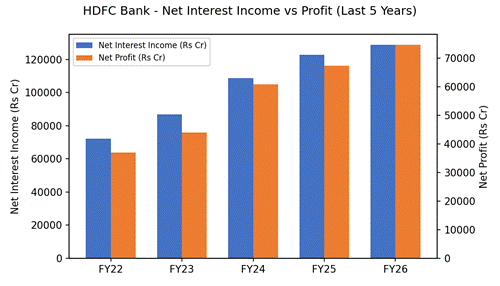
Rs Crore, as reported in the bank’s own annual financial highlights:
Both net interest income and profit have grown every year without exception, and profit has roughly doubled over this five-year period despite the post-merger drag. This is the key fact that separates HDFC Bank’s situation from a genuine value trap – the core lending and profit engine keeps growing; it’s the margin on that growth that has compressed.
Is It Cheap for a 3-5 Year Investment Horizon?
This is where the long-term lens matters more than the short-term PE snapshot:
- The discount here is unusually deep and statistically rare: a current PE near a 10-year low, roughly 26-29% below its own 3-year and 5-year averages, for a large, systemically important bank with stable asset quality, is not something that shows up often.
- The core franchise (deposits, loan book, branch network, brand) has not weakened – profit has doubled in four years and the loan book keeps growing at a healthy clip. What has weakened is capital efficiency (ROE) and margin, both of which are directly traceable to a known, one-time event (the merger) rather than an ongoing structural decline in the business itself.
- Margin recovery is the single biggest catalyst to watch. Multiple brokerages and management commentary point to NIMBUS stabilisation and improvement in the funding mix (growing CASA share back up) as the key levers that would let the stock re-rate back toward its historical multiple. This kind of margin normalisation after a large merger typically plays out over several years, which fits naturally within a 3-5 year investment horizon rather than a quick 1-year trade.
- The risk to be aware of: if CASA share keeps falling and margins fail to recover even over the next few years, the market may be right to permanently value this business at a lower multiple than its pre-merger history. The size and timeline of margin recovery, not the low PE itself, is the thing to track going forward.
Taken together, HDFC Bank looks like the more statistically compelling long-term value case between PE and its own history – the depth of the discount is real, the earnings and loan book are still growing, and asset quality has not deteriorated. But the discount exists for a genuine structural reason (merger-driven margin compression), and the re-rating case depends on that margin recovering over the next several years rather than being an obvious near-term trigger.
Disclaimer
All data used in this report has been collected from various publicly available websites (Screener, Trendlyne, GuruFocus, Business Standard, Kotak Neo, Bajaj Broking, company filings/investor presentations, etc). Enough precaution has been taken to present this data correctly, but figures can vary slightly across sources depending on the date and data basis used.
This report has been prepared purely for educational purposes as part of a research practice exercise. It is NOT a stock recommendation, and should not be treated as investment advice. Please do your own due diligence or consult a registered financial advisor before making any investment decision.
Research By
Gantavya
Research & Market Analysis Intern